
Moroccan Animals
Moroccan Animals: Morocco is one of North Africa’s most ecologically diverse countries. With more than 40 different ecosystems, the kingdom hosts wildlife ranging from desert mammals to mountain species, forest dwellers, and coastal birds. Despite its varied climate, from the scorching Sahara to the cool Rif and Atlas Mountains, Morocco is home to over 100 species of mammals and nearly 200 species of birds.
Below is a complete guide to the most iconic animals found in Morocco, with descriptions of their characteristics, habitats, and behavior.
Moroccan Animals: Dromedary Camel (Single-Humped Camel)
Many visitors are surprised to learn that Morocco’s camels are not the two-humped species. Instead, the country is home to the dromedary camel, a single-humped mammal perfectly adapted to the desert.
These camels are rarely truly wild. Most belong to nomadic families who guide their herds across grazing areas. Semi-domesticated groups also roam in southern Morocco.
Dromedaries are known for their strength, intelligence, and remarkable endurance. They withstand extreme heat by raising their internal temperature and conserve water better than almost any other mammal. Adults reach 6–7 ft in height and can live 25–50 years.
Although no longer used as daily transportation, camels remain a symbol of desert culture and are central to Morocco’s tourism industry. Visitors can enjoy camel treks through dunes and oases, making them one of the kingdom’s most iconic animals.
Moroccan Animals: Algerian Hedgehog
Found in Morocco’s woodlands and forested landscapes, the Algerian hedgehog is smaller than its European relatives. Adults measure 20–25 cm and are recognized by their large rounded ears and light-colored muzzle.
These hedgehogs avoid desert regions and prefer mild, mixed habitats where insects are plentiful. Their diet includes beetles, larvae, and other small invertebrates.
Barbary Macaque
The Barbary macaque is one of Morocco’s most famous species, and the only macaque found outside Asia. Often seen in the cedar forests of the Middle Atlas, these monkeys live in social groups and are known for their expressive behavior.
Males weigh up to 14–15 kg, while females typically reach 9–10 kg. Their short tails and sandy coats make them easy to identify. They feed on insects, roots, fruits, and plants.
The Barbary macaque is endangered, making conservation efforts especially important.
Egyptian Mongoose
Known traditionally as the “pharaoh’s rat,” the Egyptian mongoose appears throughout Morocco, particularly near rivers, farmlands, and reeds. Ancient Egyptians considered this species sacred, and mummified remains have been found in pharaonic tombs.
This agile predator measures 50–60 cm in length, with a tail that can reach up to 53 cm. Its diet includes rodents, amphibians, reptiles, eggs, insects, and occasionally fruit. Mongooses are also known for their ability to confront and defend against snakes.
Moroccan Animals: Crested Porcupine
The crested porcupine is the largest rodent in Morocco and one of the most recognizable. Measuring 60–83 cm and weighing 13–27 kg, it is covered with long, sharp quills that can reach 35 cm in length. When threatened, the porcupine raises its crest and rattles its quills as a warning.
It feeds on roots, bulbs, leaves, and other vegetation, although it may occasionally eat insects or carrion.
Aoudad (Barbary Sheep / Arui)
The aoudad, or Barbary sheep, is a mountain-dwelling species native to North Africa. With reddish-brown fur and impressive curved horns, males can reach 80 cm in horn length.
These herbivores weigh up to 50 kg and live in rugged, rocky areas. Due to hunting and habitat loss, their population in Morocco has declined significantly and is now considered vulnerable.
Moroccan Animals: Wall Gecko
Common in Moroccan towns and rural areas, the wall gecko thrives in human habitats. It can be found on walls, rocks, ruins, and tree trunks. Adults measure 15–18 cm, including their long tail.
These nocturnal reptiles feed mainly on insects and use their sticky toe pads to climb vertical surfaces with ease.
Sand Cat (Barchan Cat)
The sand cat resembles a small domestic cat but is adapted to extreme desert life. It weighs 1.5–3.4 kg and has a broad head, dense fur, and short legs that help it survive shifting dunes.
This elusive species can go long periods without drinking thanks to water stored in its prey and fat reserves. Sand cats live in remote desert plains with few rocks or vegetation.
Moroccan Animals: Maghreb Squirrel
Native to the Atlas Mountains, the Maghreb squirrel is a fast-moving rodent that resembles a ground squirrel. It measures 16–22 cm, with a tail of similar length, and weighs around 340 g.
Its fur ranges from reddish to grayish-brown, with distinctive white stripes along its sides. These squirrels live in colonies, digging burrows among rocks, meadows, and farmland. Their diet includes seeds, nuts, and fruits.
Gundi (Desert Rodent)
The gundi is a small herbivorous rodent found in southeastern Morocco and throughout the rocky slopes of the Atlas Mountains. It is 16–20 cm long and weighs around 185 g.
Gundis resemble small guinea pigs and live in groups among crevices and boulders. They are most active during the day, feeding on desert plants.
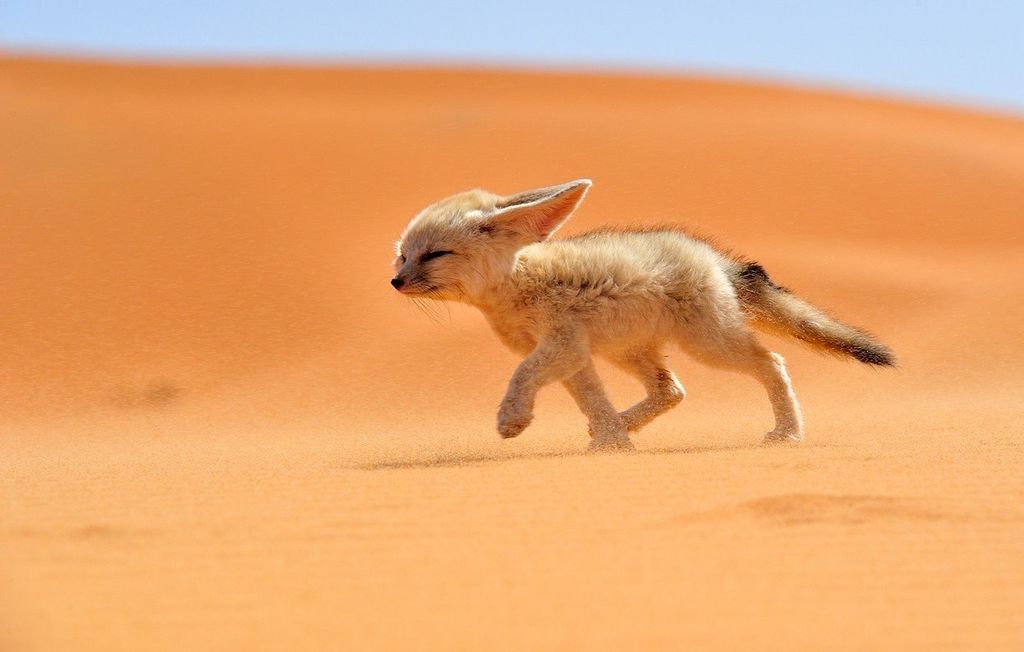
Fennec Fox
Known for its adorable oversized ears, the fennec fox is one of Morocco’s most iconic desert creatures. Its ears measure 10–15 cm, helping it release heat during the day.
Its sandy-colored fur provides camouflage in the dunes. Fennecs are omnivores, feeding on rodents, eggs, plants, and insects, and they can survive long periods without direct water sources.

